Wednesday, February 25, 2015

Preparing for the Real Thing: Mock Interviews with Etown Administration


            On Wednesday February 25th, 2015, I completed a mock interview with Mr. Steven Schoessler, the assistant principal at Elizabethtown High School. The interview lasted 40 minutes. Mr. Schoessler asked me the 11 standard interview questions that the school district uses in real interviews. We then talked through each question, analyzed my responses, and he offered me suggestions to improve my responses and better prepare me for an actual teaching position interview.  Mr. Schoessler asked me the following questions:

1) Describe your resume. How does it relate to your desired position and why do you want to work at Elizabethtown School District?
2) What factors do you take into account when planning daily, weekly, and course lesson plans?
3) How do you evaluate the success of your lessons?
4) What techniques/strategies do you use to motivate students?
5) What is important for you to know about the students you work with? How do you get that information?
6) Describe your approach to classroom discipline. How do you ensure your students are on task and what steps do you take when they aren’t?
7) Describe how you use technology in your classroom to promote student learning.
8) Explain how you would differentiate a lesson. What would the format and differentiation look like?
9) Describe what current research says about teaching agriculture.
10) Which formal/informal diagnostic techniques have you used in assessing developmental and ability levels of students?
11) How have your educational experiences prepared you for including special education students in a regular classroom?

            I felt somewhat prepared for the interview I knew some of the more standard questions would be asked such as those regarding classroom management, lesson planning, and my experience/background. I was not prepared for the question about current research in agriculture but used my experience in Schreyers and writing my thesis to my advantage. Overall I thought I did a pretty decent job on the interview questions but I know there is always room for improvement. One thing I will be sure to do for an actual interview is to prepare more questions I want to ask the interviewer. I did this today with my mock interview but could have prepared more questions that I did. (Part of this was because I have gotten to know Elizabethtown so well and questions I would have typically asked, I already knew the answers to!)  I asked Mr. Schoessler the following questions during the interview:
 

1) What do you look for in a teacher candidate?
2) What would you consider some strengths of your school?
3) What is one area that your school can improve upon?
4) How are your teachers evaluated?
5) Who would the audience be in a second round interview?

            What impressed me most about the interview was how inviting Mr. Schoessler was. He was very polite, calm, and made me feel comfortable for the interview. He also offered me great advice and suggestions as I begin to prepare for real interviews with teaching positions. He talked through each question with me afterwards and shared with me what I did very well and what areas I could improve upon. There was not anything that stands out to me that didn’t impress me about the interview. The only thing that would have impressed me more would have been if Mr. Schoessler would have created more questions to ask me other than the standard 11 questions asked by the school district. This would have given me more practice and a wider variety of questions to answer.

            In order to better prepare for a real teaching position interview, I need to take my time while answering questions and really think about how I want to answer the question. Mr. Schoessler explained that in some of my responses, I did a very good job at describing specific examples and details, but in other responses, the specifics were weaker. He suggested I talk less about theories and ideas but instead explain practical situations where I have implemented the ideas behind the theories as well as the results. After reflecting upon the interview, I know I need to make my responses more student focused. After all, I chose ag education because I want to make a difference in the lives of students! I think that I must also decide what I want the interviewers to know about me and what kind of impression I want to leave. Overall, this was a very beneficial assignment and I left the mock interview with plenty of suggestions that will better prepare me for a real interview!

Sunday, February 22, 2015

ACES Isn't Just for First Year FFA Members...

        On Saturday February 21st, I attended my first ACES (Agricultural Cooperation Establishes Success) conference with Elizabethtown FFA. Our chapter took 11 students: 4 boys and 7 girls. This was my first time attending because my high school chapter never attended the conference. I was very excited because this was also the first conference I attended with Etown FFA members. I was anxious to attend with a smaller group of students and get to know some of them much better. We met at the high school at 9:15 on Saturday morning and left around 9:45. The conference was held in Harrisburg at the Sheraton Hotel along route 283. We stopped for brunch at Bob Evans which I soon found out has been an Elizabethtown/ACES tradition for many years!

            Once we arrived at the hotel, we mingled with other teachers and FFA members until opening ceremonies began at 12:40. I sat with my students and had really good conversations until the conference officially started. Getting to know my students and having them ask my questions made me feel awesome! I felt like I would really connect with some of the FFA members this weekend at ACES and I can’t explain how happy it makes me! After opening ceremonies, FFA members and teachers were split up. Teachers went to a large conference room for several workshops while students rotated through their own workshops. Mr. Anderson and Mrs. Pontius from Greenwood completed the first teacher workshop on inquiry instruction. It was exciting to see my cooperating teacher share his experience and knowledge of inquiry instruction with other ag teachers across the state! Carole Fay also did a presentation about AET and its features while making the ag teachers familiar with the site.

            After the workshops were over, teachers and students met to reconvene before supper. We had a delicious buffet style supper as well as dessert. After supper was over, a DJ provided some entertainment between supper and the dance. Ag teachers were asked to volunteer to assist him with his performance. My students persuaded me to go up although I had no idea what I was getting into. As it turns out, we were broken up into groups of four and had to participate in a karaoke style musical performance. A different song was played for each group and the members had to finish the words. We were not given the song titles in advance, it was all a surprise. My group had to sing a country song and I was the only one who knew all the words! However, once the music cut off, my mind went blank and I had a total deer in the headlights look. It was a lot of fun but I was so embarrassed!

            Afterwards, everyone went back to their rooms and changed for the dance. All of my students went to the dance and by the end, even the boys were dancing! It was fun interacting with my students and watching some of them break out of their comfort zones and have a good time. The night ended with reflections and everyone in bed by 11pm. At 7am Sunday morning, there was a morning reflection service held before breakfast. A breakfast buffet was provided at 8am. Afterwards, an hour long service project occurred where FFA members had to write encouraging/thank you letters to current servicemen, veterans, and wounded warriors. The conference ended with closing ceremonies and we were on the road by 10:30am.

            Overall, I had an awesome time at the conference! I had a wonderful first time at ACES and could not have asked for a better group of students, or cooperating teacher, to attend the conference with. I felt like this was such a great opportunity to connect with some of my students and get to know them better. This conference, as well as seeing all of the blue jackets, reignited my love and passion for agriculture. I felt like I was making an impact when my students asked for such simple things like me to dance with them or take a selfie with them before the conference was over! Experiences like this remind me why I wanted to become an ag teacher in the first place. Here’s to some great memories and looking ahead to SLLC next month!

Thursday, February 19, 2015

An Impressive First SAE Visit


            On Thursday, February 19th, 2015, I completed an SAE visit with Mr. Anderson. We traveled to Regan Wolgemuth’s house in Elizabethtown in Lancaster County after school. We went to visit Regan on her family’s farm. Regan is a senior at Elizabethtown High School. She is president of the FFA and plays softball. In order to prepare for this visit, I talked with Mr. Anderson about a student to visit. He suggested we visit Regan because of her unique SAE project. We talked to Regan last week and made arrangements to meet on Thursday, February 19th.

            Regan’s family owns and operates Wolgemuth Custom Harvesting, which harvests wheat in the Mid-West during the harvest season as well as crops here in Pennsylvania. The company is owned and operated by her dad and uncle. Her family has been harvesting wheat in the Mid-West for over 30 years. The company has been working in Pennsylvania for over 20 years. Regan’s brother and cousin work for the company and it is very family oriented. After graduation, Regan would like to continue working for the company and will most likely take over office work. Her SAE project was an employment SAE with on-farm work experience. As part of her SAE project, Regan assists with cutting of crops, hauling crops, and office work.

            After viewing Regan’s farm and her SAE project, I would rate the program as excellent. I was very impressed with Regan’s SAE project and her family’s company in general. The idea of custom harvesting was new to me, especially when it occurs here in Pennsylvania and in the Mid-West. Regan’s family farms upwards of 2,000 acres in Pennsylvania and owns several hundred acres in the Mid-West. The company owns 5 tractor trailers, 5 combines, and several pieces of harvesting equipment. At her family’s farm, there is a large grain bin storage system set up. Most of the grain stored is grown by Regan’s family but some is bought from local farmers.

            One recommendation I suggested to Regan is to continue maintaining her records and earn her American Degree next year. Regan has a very interesting SAE project and would certain qualify for her American Degree. Regan utilized the Pennsylvania State record book system in order to keep track of her SAE records. Regan earned her Keystone Degree this past January at Mid-Winter Convention at Farm Show. She has been an FFA member all four years and started her SAE project early on. The cooperating teacher does not give an “official” grade for SAE. The concept of SAE is incorporated into all classes. SAE is not a stand-alone course and no extra credit is given for SAE.

            Overall, I had a great experience visiting Regan at her family’s farm, despite the blustery cold and wind. Regan has a very unique SAE project with a hardworking, dedicated family behind her to support her. It is evident that Regan is just as hard working and passionate about agriculture as her family. I am anxious to work with Regan in class and with FFA and see where her SAE project takes her!

Week 6: A Shortened Week with Lots of Learning!

           Week 6 began just like every other week of student teaching so far…with snow! Elizabethtown did not have school on Monday in order to observe and celebrate President’s Day. On Tuesday, the school district had a two hour delay due to snow. I believe this makes the first day of every week since student teaching a two hour delay! I picked up another class and will now be teaching second block agricultural mechanics as well as third block aquatic resources! In ag mechanics second block, students practiced butt welds and turned in their best weld for grading. There are 17 boys and 1 girl in the class so I was a little intimated but I think the course will run just fine! In aquatics, we continued with water volume problems. Students solved for the volumes of the fish tanks in the aquatics lab before starting a water volume project. I heard many moans and complaints as I walked around to answer questions and assist students. At the end of the period, I felt a sense of accomplishment because I was able to answer questions and help students understand the mathematical component!

            I started off second block ag mechanics with my first teaching lesson on Wednesday. I did an introductory lesson on electrodes. I was a little nervous because it was my first time teaching this class. While I have been observing and interacting with the students over the last several weeks, I did not know all of them individually yet. The class consists of 17 boys and 1 girl. I was a little intimidated to be honest because I felt like some of the boys knew more about welding than I did; whether that was entirely true or not I was unsure. The lesson went pretty well overall, although I did notice that I spoke too fast in the beginning. I think this was because of my nerves. This lesson required some time spent after school reading up on electrodes and talking with Mr. Anderson in order to make sure I understood what I would be teaching.

            In aquatics, students worked on their water volume projects from Tuesday’s class. I struggled a little with this period because students finished at different times. Several students were finished early in the period, many of the students finished throughout, and several students used the whole period because they really struggled with the mathematical equations. I had another assignment for students to work on as they finished their water volume projects. Mr. Anderson also took the students who finished early over to the aquatics lab to clean the tanks. I stayed in the classroom and worked with students individually who needed assistance with the project. The class went fairly well overall but I need to figure out how to balance all of the learning abilities in my classroom!

            On Thursday, I had an awesome lesson planned for ag mechanics. I utilized the edible electrodes lesson plan from Lincoln Electric and my students loved it! I adapted the lesson to fit the class period and didn’t use every worksheet provided. I began the lesson by showing a “How Its Made” video on electrodes. I then transitioned into a worksheet which allowed students to practice breaking down the numbers on an electrode. I then moved into different metals used in electrodes, their properties, and then had students draw the 6010 electrode before they were allowed to create their own and eat it! I had students do the same with the 7018 electrodes. My students were very excited about the lesson and enjoyed the hands on component. In aquatics today, I began teaching students about stream flow, the last topic in the water calculations unit. I again faced the same problem as earlier in the week with some students finishing quickly, some taking their time, and others not catching on as fast. Students only had a few minutes to get started on the project today and will finish it tomorrow. I have a worksheet and another activity planned for tomorrow in hopes of combatting this problem. I also completed my first SAE visit after school which was very informative and a lot of fun!

            I will not be teaching tomorrow because I will be at Penn State for our February student teaching cohort meeting. Mr. Anderson will be teaching my classes for me. As I look ahead to the coming week, I have a lot of exciting things planned! I will be bringing an officer from the PA Fish & Boat Commission in to aquatics on Monday. He will be talking about stocking with the students. We will be finishing up our water calculations unit on Tuesday with an in class assessment. We will begin talking about water quality and start completing measurements to finish up the week. In ag mechanics, students will continue to work on lap welds. I will teach students about joints and they will begin working on t-joints to finish up the week. I have some more interactive, hands on lessons planned and I’m excited to see how things play out!


Friday, February 13, 2015

Week Five: 1/3 of the Way Already?!

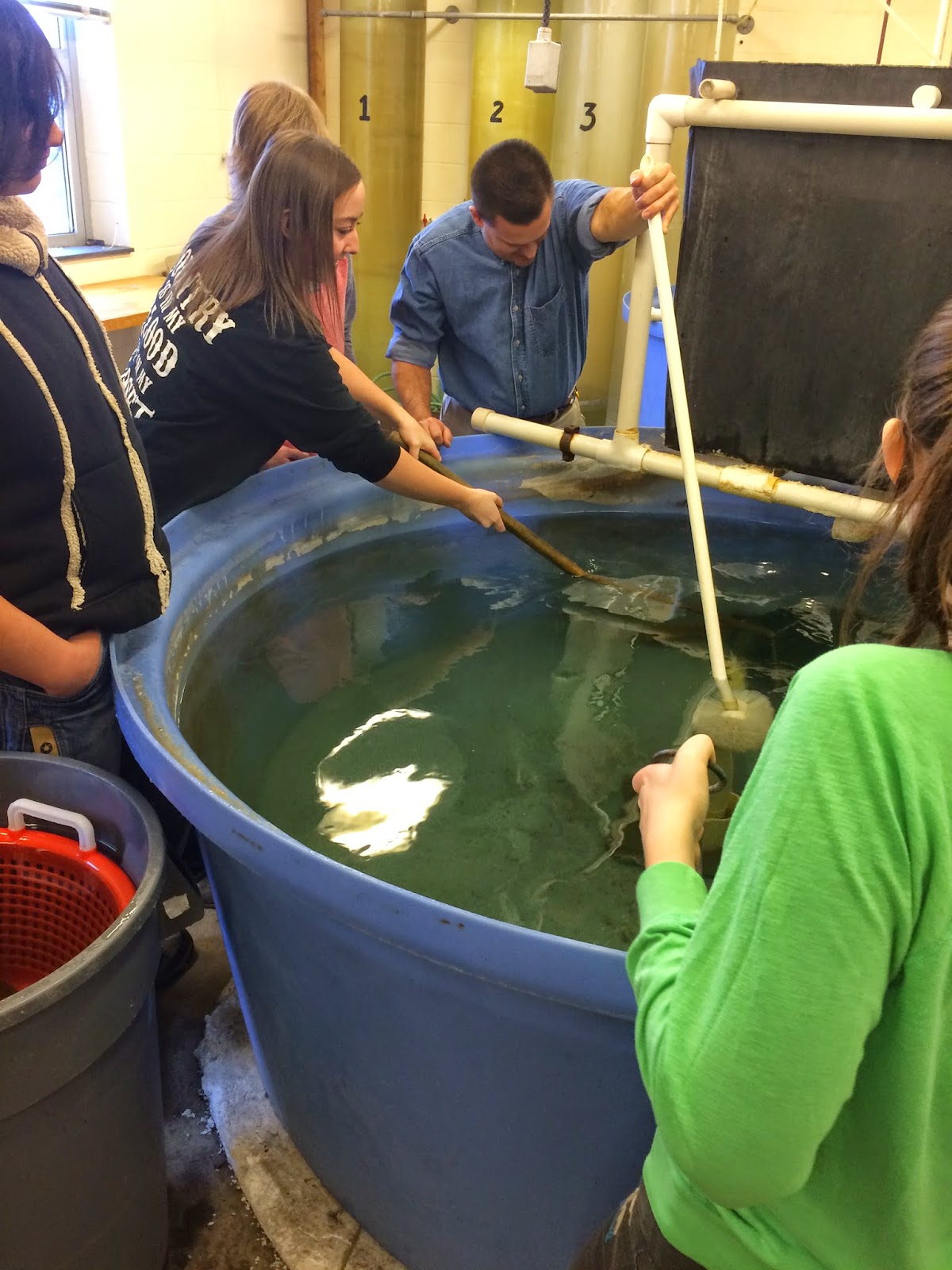
             I started off Monday feeling refreshed and excited for another week at Elizabethtown! I made copies and got everything prepped for the week during my prep period. I supervised students as they welded during agricultural mechanics in second block. For aquatics today, I wanted to try something new and work in a water debate in the class. I created a scenario about a town having to decide who gets access to the water in the local river. I broke students up into four groups: farmers, outdoor recreationists, water company workers, and power plant employees. I also had a four person group who acted as state congressmen and had to make the final decision. The students had to work in their groups to come up with arguments, present the arguments, answer questions from the congressmen, and then provide a rebuttal. Students seemed a little hesitant at first but once the rebuttal started, the students became much more outspoken and wanted to keep going. I think my directions weren’t as clear as they should have been in the beginning but overall I think the debate worked well! Class ended by cleaning the fish tanks in the aquatics lab.

            On Tuesday, I gave students a quiz in aquatics. I got the chorus of groans and “why’s” on Monday when I informed my students that they would be having a quiz. After the quiz, I asked students how they thought the quiz went and the most common response was that it wasn’t actually that bad. After the quiz, students finished putting together the wetlands display that they have been working on the last few days. The final product looks pretty awesome and I am pleased with my students’ work. To finish up class, I gave my students a pretest with four questions related to calculating water volume. The students were not happy with math and it seems like as a class overall, they struggle with math. The rest of this unit will be fun!

            Wednesday was the day I had scheduled to weigh and measure fish. Class started off with a page and a half of notes highlighting why we weigh and measure fish, its importance, as well as the procedure students would be following for the day. Students seemed to enjoy weighing and measuring fish, although I can’t say the same thing for the fish. I rotated several students for the actual weighing and measuring part; it required them to actually hold the fish. I think it was a combination of the students having a fear of the fish, the fishes’ slimy scales, and the fishes’ continual flopping but most of the 46 fish we weighed and measured ended up on the floor at some point. I wanted students to chart fish growth by tank as well as overall by averaging the growth in length and weight. Students became easily frustrated, partly because of my unclear directions and partly because they didn’t want to graph any results. Class ended with everyone frustrated and I felt a little defeated. After talking with Mr. Anderson, I had a solid plan for Thursday and was ready for a brand new day!

            On Thursday, I stated off class by apologizing for my unclear directions Wednesday, thanked students for their patience, and for being flexible through the whole process. I felt much better about class on Thursday and students seemed to feel better as well. I gave students class time to make their graphs. For the record, handing students a paper with clear, explicit directions and your expectations works much better than just a verbal explanation! I will remember this for the future. We finished up class with notes and a worksheet. Friday was a half day and we took notes on calculating water volume, as well as started practice problems. I quickly realized that I must be very specific and detailed, especially when it comes to mathematical problems. As I look ahead to next week, aquatics will continue with water calculations and complete two mini calculation projects. I will begin teaching ag mechanics next week as well! I’m a little nervous for this but more so excited! I will begin teaching about welding electrodes and plan to complete the Lincoln Electric edible electrodes lab! Here’s to an awesome week 6!


Friday, February 6, 2015

Week Four: One for the Books

          Monday started off as a normal day with no two hour delay, despite the slushy mess outside! I was thankful for the normal schedule to keep my lessons on track until an announcement was made that Elizabethtown was getting an early dismissal at 1pm. I managed to cover most of what I wanted in the shorter class period. This just reiterated the fact that as a teacher, I must be flexible! The students were excited to be getting out early and were chatty during class. Other than that, they seemed interested in the lesson and managed to give me their attention. One thing Mr. Anderson did talk to me about after this lesson is learning to work on my wait time as far as getting students’ attention while they are talking or not paying attention. This is something I want to make sure I have a good handle on now so it doesn’t get out of hand as the semester goes on.

            On Tuesday, I had to teach my lesson a little backwards but it ended up working out. I started off class by allowing students to finish the notecards they were working on yesterday. This took longer than I had anticipated. I then gave students an article about why it is important to protect and preserve wetlands to lead into today’s lesson. After going over the article, I taught my lesson while students took notes. I had planned to show a twenty minute video with a worksheet in today’s class but ended up running out of time, something I didn’t think would happen with block scheduling! I took the students out to feed the fish and that wrapped up class. I was very excited about today’s lesson though because I took Mr. Anderson’s advice from my observation yesterday and put in place today. Wait time actually does work! I used it twice today in class and my students stopped talking. I also made sure to explain why today’s lesson was important and why it matters. I felt good about today’s lesson!

            Dr. Ewing visited for my first observation on Wednesday. I wasn’t nervous at all; I was actually really excited for the lesson! Since I was teaching about wetlands this week, I chose to have students complete an inquiry lab about oil spills while Dr. Ewing was there. I started off the lesson with a real life experience about an oil spill in Harrisburg in 2013 that affected the wetland at Wildwood Park where I was interning that summer. I showed pictures and described what happened for the first few minutes of class. I then introduced the inquiry lab, a simulated oil spill, and gave students brief directions for what they would be doing. I took students over to the shop where I had the lab set up and allowed them to work. Students had to use materials provided to determine what best cleans up an oil spill. It didn’t hit them until about half way through that in order to determine how much oil was soaked up, they should have weighed the material before and after! I finished off class with a Bill Nye the Science Guy movie about wetlands.

            I think this observation will be Dr. Ewing’s most interesting because in the last five minutes of class, I ran out of the room and headed to the bathroom. I ended up throwing up all over the bathroom and getting some on myself. I was very embarrassed to say the least. As a result, I was not able to go to school on Thursday because I had a fever of 101. I was able to return to school on Friday. I got to practice welding in second block. In aquatics, I caught up with what I missed on Thursday. My students were working on creating a wetland in the display case outside of Mr. Anderson’s classroom. Students worked on the different aspects of the wetland: plants, animals, water, mammals, reptiles/amphibians, background, and informative sign. The final piece will come together on Monday and I am so excited to see the final project! As I look ahead to next week, we will wrap up wetlands on Monday. Tuesday we will begin water calculations. I will be bringing a math teacher in to assist with some of the lessons when I begin teaching math. We will also be cleaning the fish tanks next week as well as weighing and measuring the fish! Bring on week five!


Friday, January 30, 2015

Watersheds, Welds, and Winter Storms: Week 3


           Week three of student teaching started off with not one but two two-hour delays! Both Monday and Tuesday of this week, Elizabethtown School District had a two hour delay from the hyped up blizzard of 2015. I was thankful school was not closed and appreciated the few extra hours of sleep I got each morning. I was well rested Monday morning and ready for another awesome week at Elizabethtown. I made all of my copies for the week on Monday during my prep period, something I plan to do each week as I develop my routine. I started off the week by teaching about the three major types of aquatic ecosystems in my aquatic resources class. The class was a few minutes shorter than normal due to the delay. I wasn’t paying attention when I looked at the clock and seemed to rush through the material only to find out I was going by the normal schedule and not the two hour delay. Talk about panic! I had my students create a poster where they had to depict and differentiate the three different types of aquatic ecosystems. Between the notes, poster, and feeding the fish, class ran right up until the bell. My biggest takeaway from Monday: slow down and be able to think on your feet!

            Tuesday started off with another two hour delay. The extra sleep had me well rested and ready for an awesome day. In aquatics, I shifted the focus to abiotic and biotic factors and how they influence aquatic ecosystems. After reviewing some notes, my students created a poster of a chosen aquatic ecosystem and drew and labeled 8 biotic factors as well as 4 abiotic factors. Class ended with a short article, worksheet, and feeding the fish in the aquatics laboratory. I felt much better about class today and thought it was my best lesson yet! I felt very comfortable in front of the students and many were asking great questions throughout the lesson! I felt very good about class today and hope great days like this one continue!
 

            On Wednesday, we had a normal school day, no two hour delay today! In aquatics, I taught my students about watersheds. I started the class off with a few notes and had the students color and label a map of Pennsylvania and its six watersheds. My students then had to read a short article about watersheds in Pennsylvania and complete a short worksheet. To finish the class, I introduced students to the end of unit assessment watershed pamphlet project. Students were required to choose one city of four possible choices in Pennsylvania and create an informative pamphlet about the watershed the city lies in. I provided a descriptive paper as well as a rubric so students would have a better understanding of the task and how they would be graded. 

            Students were given the entire block on Thursday to work on the project since it is an in-class project. I stayed after school Thursday night up until the parent/teacher open house. The event started at 6:30 and concluded at 8. I enjoyed meeting some of my students’ parents, even if it was only a few parents! Friday in aquatic resources was another work day for students. Most of the students finished up their watershed research project about half way through the block. I handed out the next assignment that I had planned to do with students during class today. I had planned a debate surrounding the issue of water usage. Students selected a viewpoint to represent and started formulating arguments and key points. Class ended with a visit to the aquatics lab to feed the fish.

            This week was busy, productive, and fun! I have gained a deeper insight into the logistics of teaching, especially with planning, preparation, and adaptations/accommodations. As I look ahead to next week, I will be having my first visit from Dr. Ewing, my university supervisor on Wednesday. I have planned a mini unit on wetlands with the help of Mr. Anderson and I am super excited about it! My students will be learning about wetlands, completing several in class activities, and then creating a wetland display in a display case in the hallway! I practiced welding several beads at the end of the week and will have more opportunity to practice next week as well.  It’s been an awesome three weeks so far and I can’t wait to see what the coming weeks have in store!